
Vanity awards – research by The Independent Awards Standards Council
Vanity awards and pay-to-win awards – how to spot and avoid them
“Congratulations, you have been nominated for an award, click here to complete your application.”
If you receive this email, and did not apply for these awards, then this is probably a vanity award scheme trying to get you to part with money in return for a nice sounding, but ultimately meaningless, vanity business award.
In recent years, as the appetite for credible awards has grown, so vanity awards have proliferated, muddying the waters and leaving potential awards applicants unsure which awards to enter, and all-to-often put off applying. This article will share the findings of recent research, help you identify and avoid vanity awards, and recommend what the industry can do to avoid them.
Our definition of vanity awards
So, to start with, what do we mean by ‘vanity award’ in the context of business awards? We define a vanity award as a paid-for accolade where the primary criteria for winning is paying money to the organisers, rather than a rigorous assessment process involving respected industry peers and transparent judging processes. Awards should be based on sharing best practice and recognising the outstanding, whereas vanity awards are typically driven by profit. They exist to sell trophies, certificates, or “winners packages” to as many companies as possible.
Does this matter?
Does this even matter? Surely we can just ignore them? The answer to these questions appears to be “no”. Research by Boost Awards (surveying 100 business people with an interest in awards) published in 2026 demonstrated how significant the issue of vanity awards is:
- 14% of respondents have been caught out by a vanity awards programme in the past (a minority, but that translates to a LOT of businesses in the marketplace)
- 36% of respondents are put off entering awards by the proliferation of pay-to-win vanity awards.
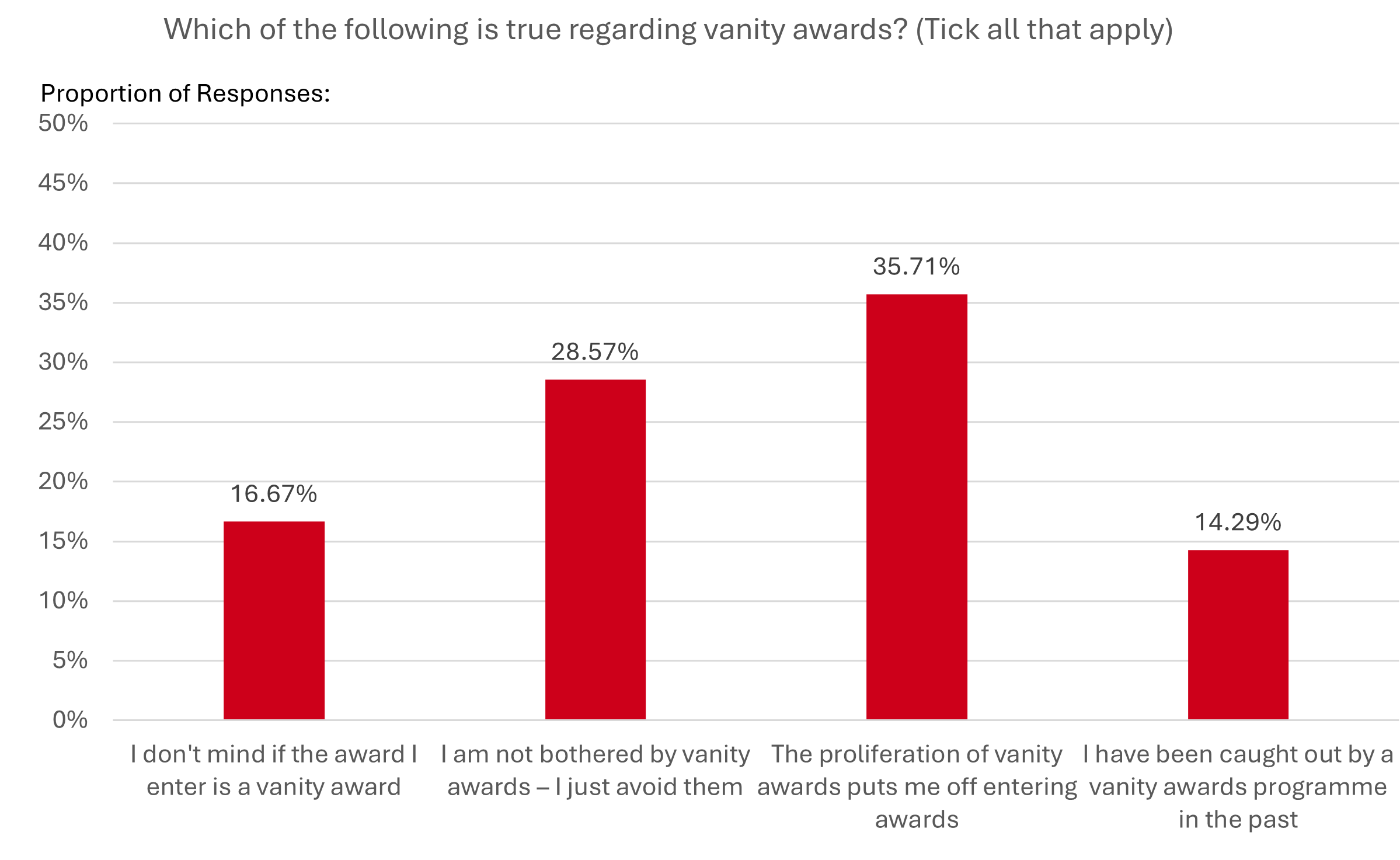
Market research published in 2026 by Boost Awards quantified the scale and impact of Vanity Awards
This latter statistic shows just how damaging these programmes are. Although 29% of respondents are ambivalent about vanity awards, and 17% are fine to enter them, the awards marketplace loses the interest and support of over a third of its potential market due to these awards schemes.
The appetite for an accreditation
The Awards Trust Mark exists to help businesses spot the very best practice. Any awards programme carrying a logo has been scrutinised and a director there has signed up to the published code of conduct they are accredited to. The need for this was quantified in the research mentioned, which showed that about 40% of those looking for awards to enter would be more motivated to enter an awards programme if it carried “an accreditation of ethics like the Awards Trust Mark”. The other things that would motivate them to enter are, by no coincidence, many of the things that the Awards Trust Mark includes in its code of conduct.
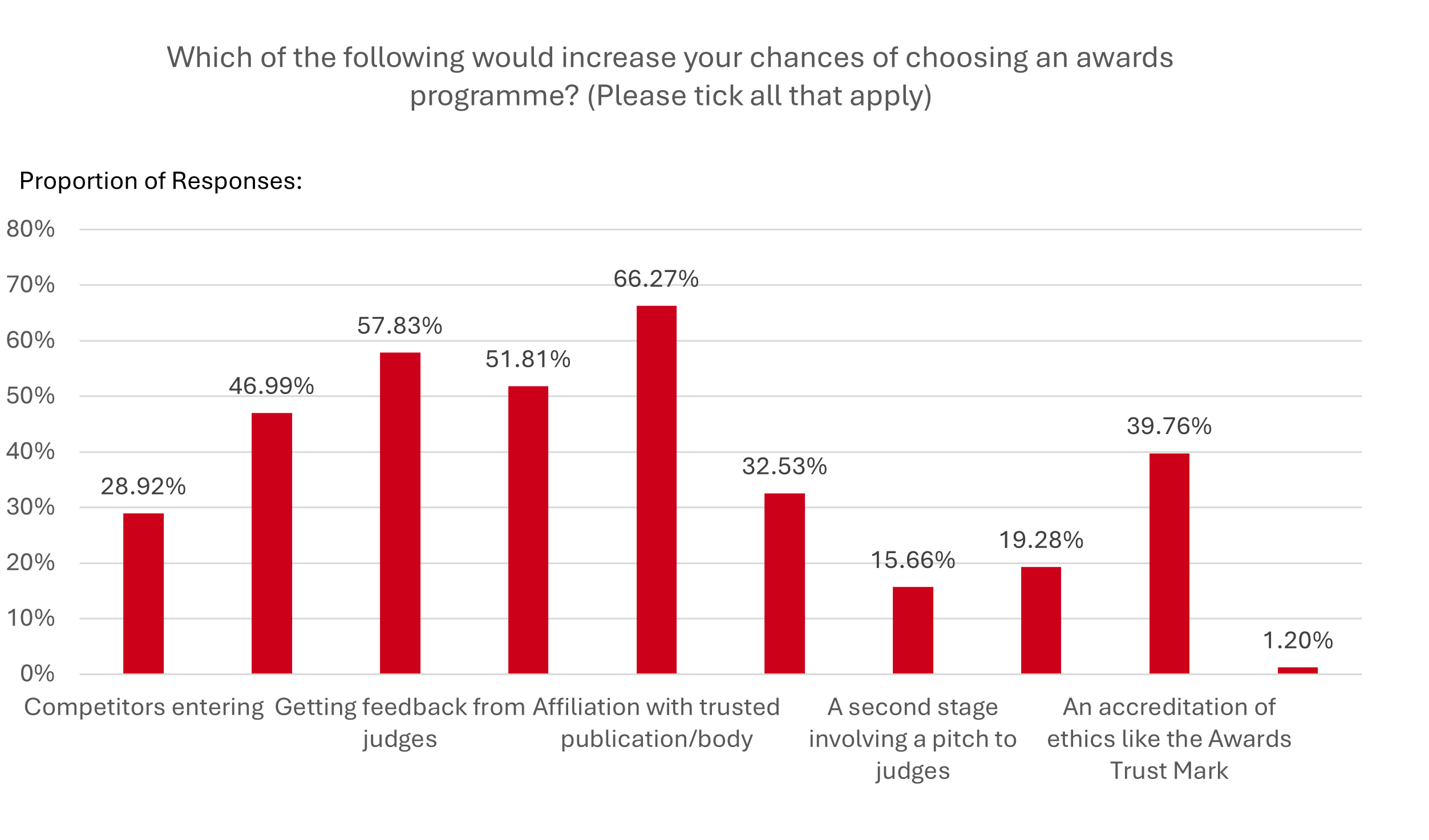
“An accreditation of ethics like the Awards Trust Mark” is a substantial positive factor in people picking which awards to enter.
Do people want help?
It is sad to say that the situation with vanity awards is so dire that 38% of those surveyed said they would value a database of vetted awards, and 46% wanted help (presumably from independent external experts).
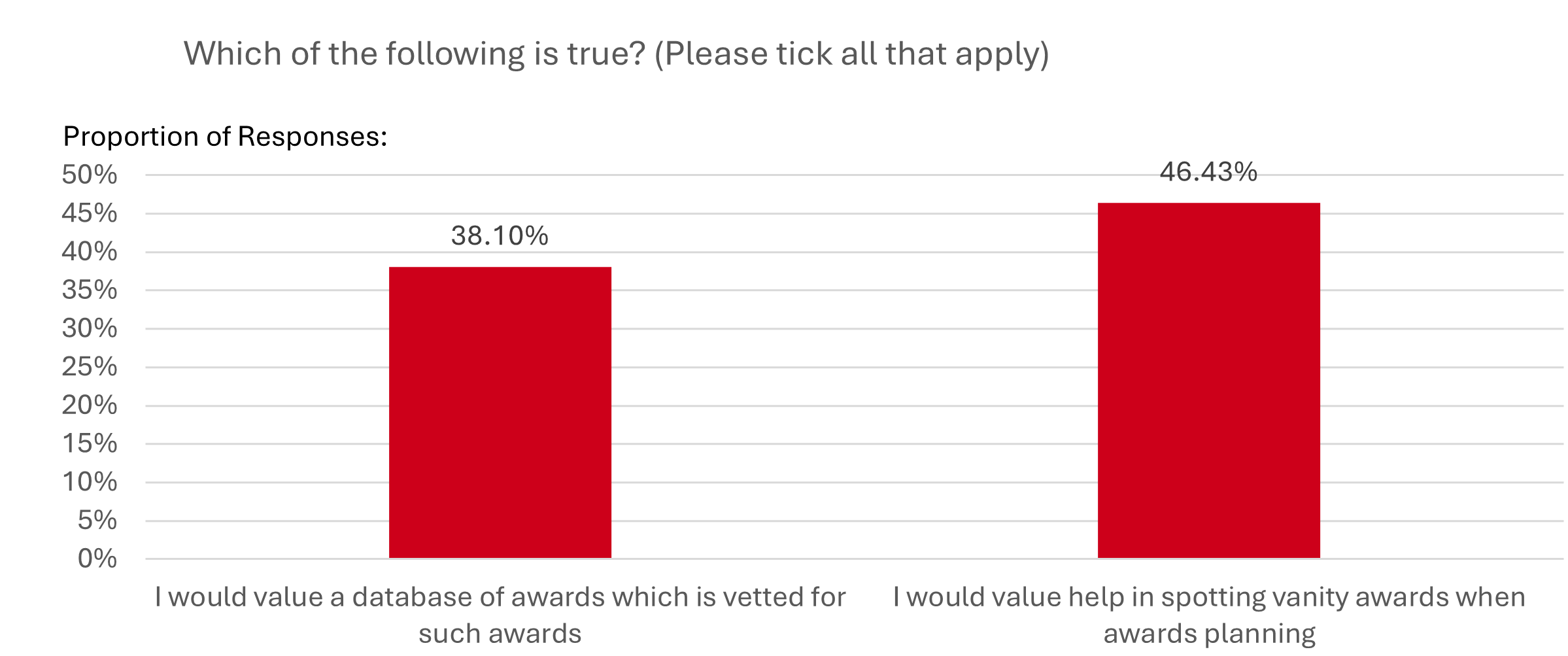
The good news is, both exist. There are also things you could do to spot the worst offenders quickly, as we will explain below.
How to spot vanity awards?
Some awards are getting very good at hiding the fact that they are pay-to-win vanity awards, but the vast majority wave a number of the following red flags:
- The costs kick in after winning: For the vast majority of credible awards the fees tend to be before the winner is announced, whether this is entry fees or event attendance fees. Vanity awards, however, offer substantial advertising packages and “winners packs” which shift the costs to the other side of the announcement. This makes it fair to call them a “Pay-to-win” model. This is not a 100% tell-tale sign though. Sadly a lot of awards out there that are credible and have a very clear judging process do still charge money for using a logo or receiving a trophy. These awards will never carry an Awards Trust Mark, but they might well be worth considering if this price isn’t prohibitive and the awards are otherwise worth entering.
- No published shortlist: The vast majority of credible awards have a shortlist every instance, and the winner is the best of the shortlist. That said, this is also not an immediate dealbreaker, as many incredibly credible awards and rankings like The King’s Award for Enterprise and The Times Top 50 Employers for Gender Equality do not have a shortlisting stage, but it is worth mentioning because all vanity awards have this in common.
- A huge list of winners: The most successful vanity awards can share substantial lists of winners. Often with random categories, which appear to be made up for the benefit of each winner. On the worst offending websites there are lists of CEOs and small businesses you can scroll through for ages, sadly a roll call of those scammed. Again, this doesn’t mean a dealbreaker automatically, some very popular international awards have huge lists of winners, but these only represent a minority of applicants.
- Emails out of the blue: As referenced in our opening line here, getting an email about a nomination out of the blue is often the first red flag. If you do, then you can ask them to tell you how they decided to nominate you. If they say “research by our team” or some other excuse like this, then bin it. You may just be an entry on a purchased mailing list.
- No credible associations: Credible awards usually have credible sponsors, high profile judges and business ties with credible magazines, institutes etc. Vanity awards either have no ties, or create links to digital-only publications that no one has ever heard of. Also be wary of wildly exaggerated reach and engagement figures, social media and readership claims in the millions. Credible awards don’t need to shout “We are credible!” so loudly.
- No event: The vast majority of business awards have a ceremony to announce the winner, mostly in person at an event or as part of a conference or exhibition. An awards website that doesn’t have photos of the actual awards event (watch out for stock photos) should be checked thoroughly for the other red flags mentioned.
Some awards fall in the grey area of being sort of credible, but also having a healthy dose of bad practice typical of vanity awards. These:
- Publish some kind of independent judging panel and process.
- Do not necessarily recognise every paying entrant with an award.
- Charge people for winning with some rationale like “why should unsuccessful applicants have to pay anything?”
What should the awards industry do?
As explained earlier, the awards industry as a whole is being harmed by the proliferation of these nonsense awards. There is not formal regulation of the industry, so it needs to self-regulate. The code of conduct for the basic Awards Trust Mark indicates the basic standards every award should subscribe to, and if they do, let the Awards Trust Mark know and check this, and share your accreditation logo with pride.
A list of awards you can trust
The Awards List sites, which can be found at www.awards-list.co.uk and www.awards-list.com are vast listings of over 5,000 business awards, and importantly, are vetted by the team at Boost Awards, and all programs that appear to be vanity awards are not listed (the exclusions include all those in the article below). The Awards Trust Mark status is also shown.
A list of vanity awards to avoid
This article by the Global Good Awards (a sustainability awards programme that raises the bar on ethics in the awards marketplace) names and shames many of the worst offenders. We highly recommend you check any award you are considering entering against this list: https://globalgoodawards.co.uk/vanity-awards/
It is also worth reading the Wikipedia entry for vanity awards https://en.wikipedia.org/wiki/Vanity_award which also lists many of the worst offenders.
Expert help choosing the right awards
Because it is possible to waste so much money by entering the wrong awards, and gain so much positive recognition by entering the right awards, it is not a bad idea to reach out to awards experts. Two of the members of the Independent Awards Standards Council, which is behind the Awards Trust Mark initiative, represent the leading awards agencies in this space – Boost Awards and Awards Writers.
Conclusion
In conclusion, winning awards is of value when it comes to improving potential and existing clients, talent, and investors, but awards which do not bear up under scrutiny will not help here in the long term. Build a plan of which awards to enter using a trusted awards list site, vet this list thoroughly yourself, and focus on them regardless of what lands in your email in tray.